
NEW WHITE PAPER: Deep learning for advanced users
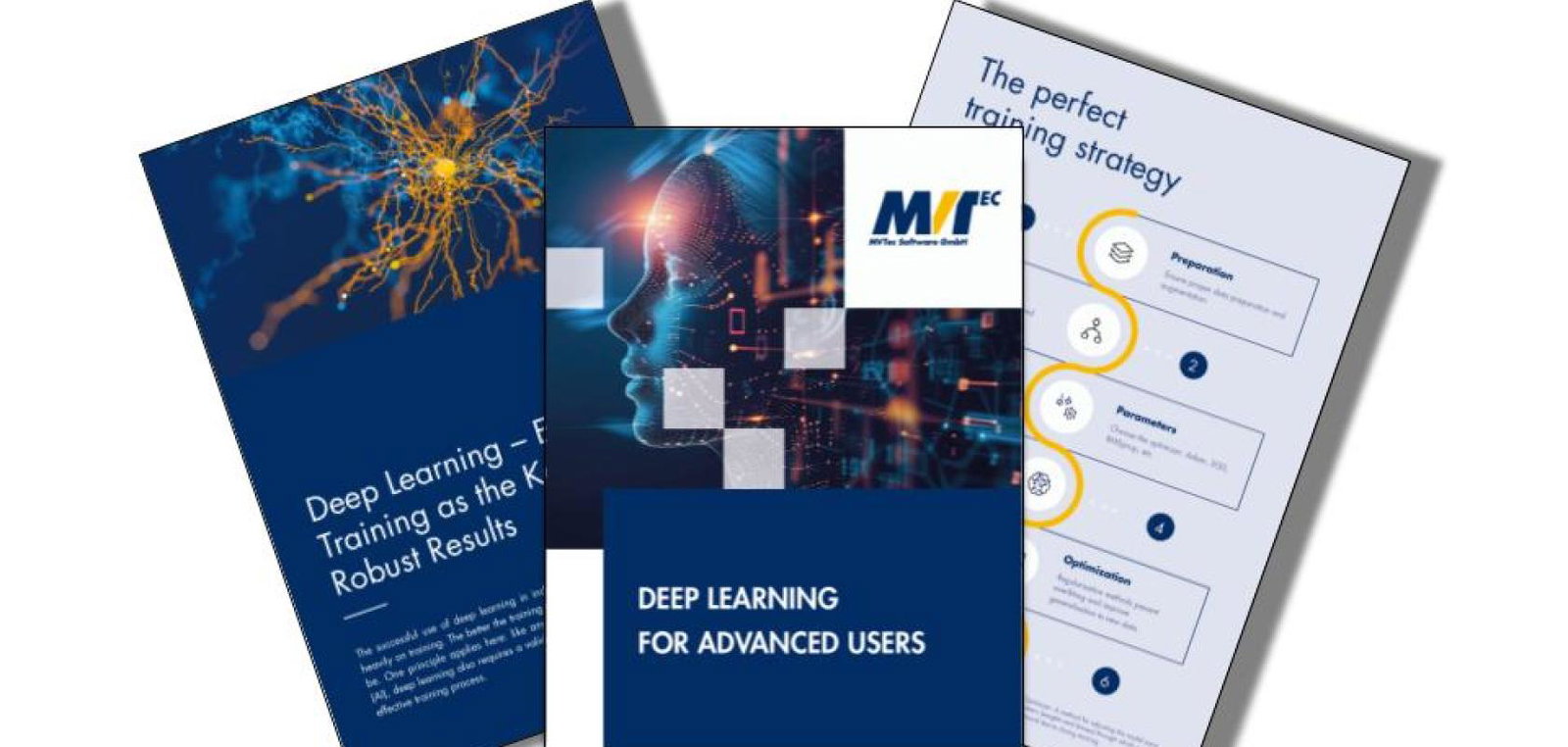
Deep learning for advanced users - An MVTec White Paper
Deep learning is now well established in machine vision and is widely used across industries. It delivers recognition rates that were previously out of reach and automates applications that were once considered impractical. Yet many organisations still fail to get the full value from it, missing opportunities to raise performance and scale their AI-based applications.
This White Paper explains how to get more from deep learning. It covers how to optimise the training process, why data quality matters, which training strategies to consider, and how deep learning can be combined with rule-based methods. It also looks at how AI accelerators such as GPUs and NPUs make these models practical to deploy, without major changes to existing industrial hardware.
What you’ll learn from reading “AI in Machine Vision”?
- Why data quality and annotation are critical to training success, and how variation, class balance and consistent labelling affect results.
- How to choose a training strategy, including augmentation, learning rate scheduling and when to use transfer learning.
- How continual learning adds new classes without starting from scratch, and how out-of-distribution detection flags objects a model has never seen.
- How deep learning and classical machine vision can work together in sequential pipelines, with a worked example from baked goods inspection.
- How AI accelerators support efficient inference in space-constrained industrial environments.
Who should read “AI in Machine Vision”?
Machine vision engineers, system integrators and automation teams planning to add deep learning to existing inspection, measurement or identification systems will find practical guidance on training, integration and hardware. Product and project managers weighing deep learning against rule-based methods will get a clear view of where each approach works best.
Why do I need to download “AI in Machine Vision”?
Many machine vision applications rely on rule-based classifiers that take significant effort to configure by hand. Deep learning can reduce that effort, but only when it is trained on the right data, with the right strategy, and integrated sensibly with the systems you already have. This paper helps you avoid common pitfalls and see where the technology delivers the most value.
What will I learn about deep learning in machine vision?
By downloading this white paper, you will discover:
- Data foundations: How image variation and annotation quality shape model robustness, and why overfitting can hide poor data.
- Training choices: When to use good and bad images, how augmentation expands a limited dataset, and how learning rate scheduling refines training.
- Smarter models: How continual learning avoids catastrophic forgetting, and how out-of-distribution detection supports live operation.
- Hybrid systems: How deep learning and classical methods such as blob analysis work together, with a step-by-step example of inspecting bread rolls on a conveyor.
- Efficient deployment: How NPUs and GPUs can be matched to the application, including where space and cost rule out a full-size GPU.