
Illumination: The foundation of AI machine vision performance
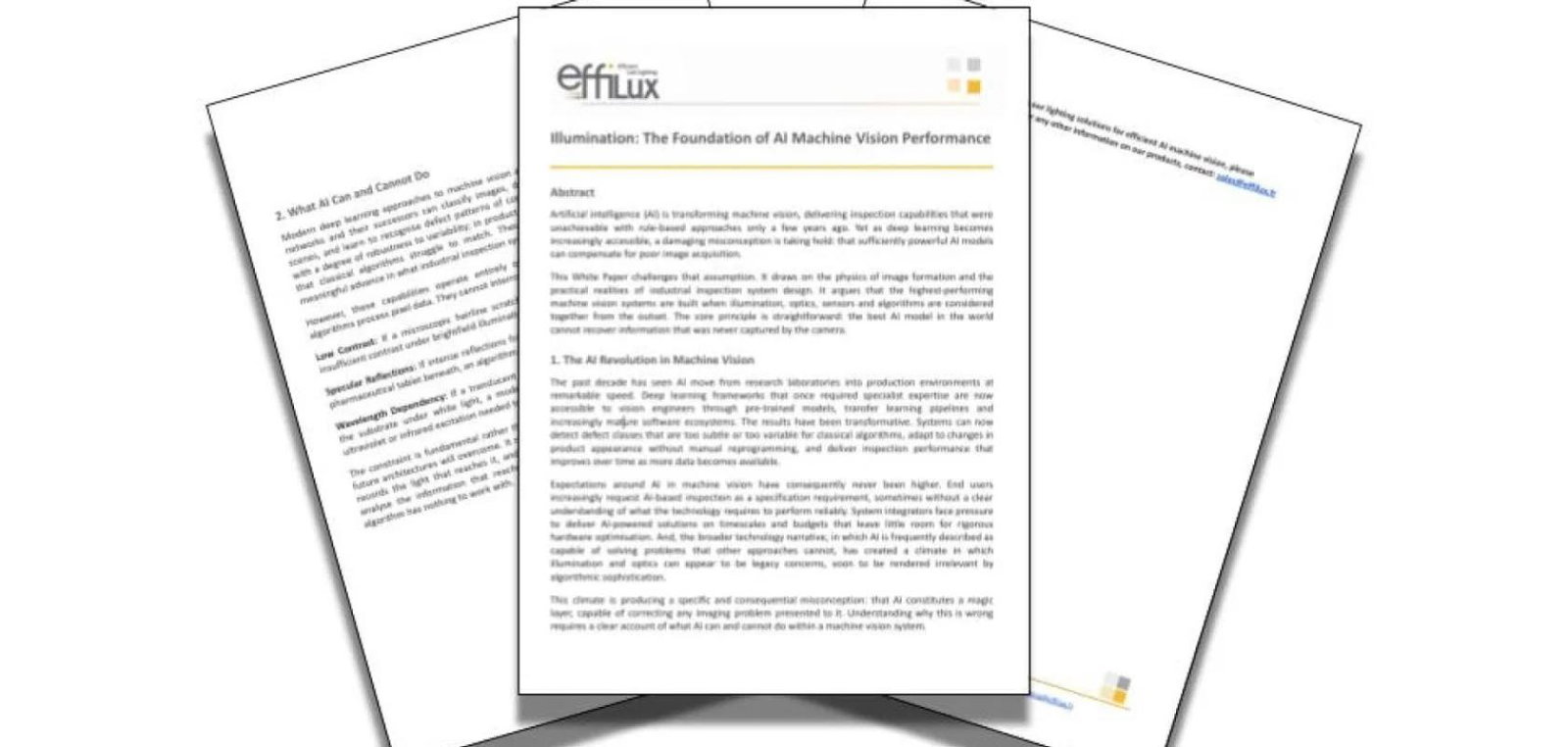
Illumination: The foundation of AI machine vision performance - An EFFILUX White Paper
AI-based machine vision is a powerful tool - but it can't fix poor lighting.
Download this white paper to see how complementary lighting, automation and photonics underpins stable, high-performance deployment.
As deep learning becomes more accessible, a damaging misconception is taking hold: that sufficiently powerful AI models can compensate for poor image acquisition.
While artificial intelligence (AI) is helping to realise previously unachievable inspection capabilities, the highest-performing machine vision systems are built when illumination, optics, sensors and algorithms are considered together from the outset. Neural networks process pixel data - and that output is only as valuable as the initial input.
This White Paper draws on the physics of image formation and the practical realities of industrial inspection system design. The core principle is straightforward: the best AI model in the world cannot recover information that was never captured on camera.
Download to discover:
- The fundamental flaw in AI: why even the most advanced deep learning models cannot recover information or defects missed by the camera sensor.
- The invisible cost drain: how bad lighting leads to extended development cycles, with bloated datasets and endless model maintenance; and why relying on software to fix poor image quality can prove costly.
- Accelerating ROI: why a simple lighting adjustment can be far more efficient long-term than upgrading computational hardware or expanding software complexity.
- Unlocking feature contrast: how precise adjustments in illumination geometry, narrow-band wavelengths, and cross-polarisation instantly eliminate glare and reveal hidden, subtle defects.
- Building an "AI-ready" vision stack: why modern inspection systems require co-designing hardware and algorithms from day one; and how treating illumination as "information engineering" ensures stable, high-performance deployment.
Who should download this white paper?
This White Paper is critical reading for:
- Machine vision engineers and system integrators looking to balance hardware selection (illumination, optics, sensors) with software development.
- AI developers and data scientists training deep learning models for industrial inspection, who want to improve model robustness, cut down on dataset size requirements, and eliminate image-quality bottlenecks.
- Automation and quality assurance managers who evaluate ROI on inspection technologies, manage false reject/positive rates, and seek to reduce ongoing system maintenance costs.
- Technical decision-makers and product managers who define project requirements and need to avoid the costly misconception that software/AI can compensate for poor hardware design.
Download the white paper
Adjust your approach to combining lighting and AI capabilities. Learn how to achieve clear pictures with optimal illumination by design, today.