
Machine vision beyond the camera: navigating complexity to reach production-ready systems faster
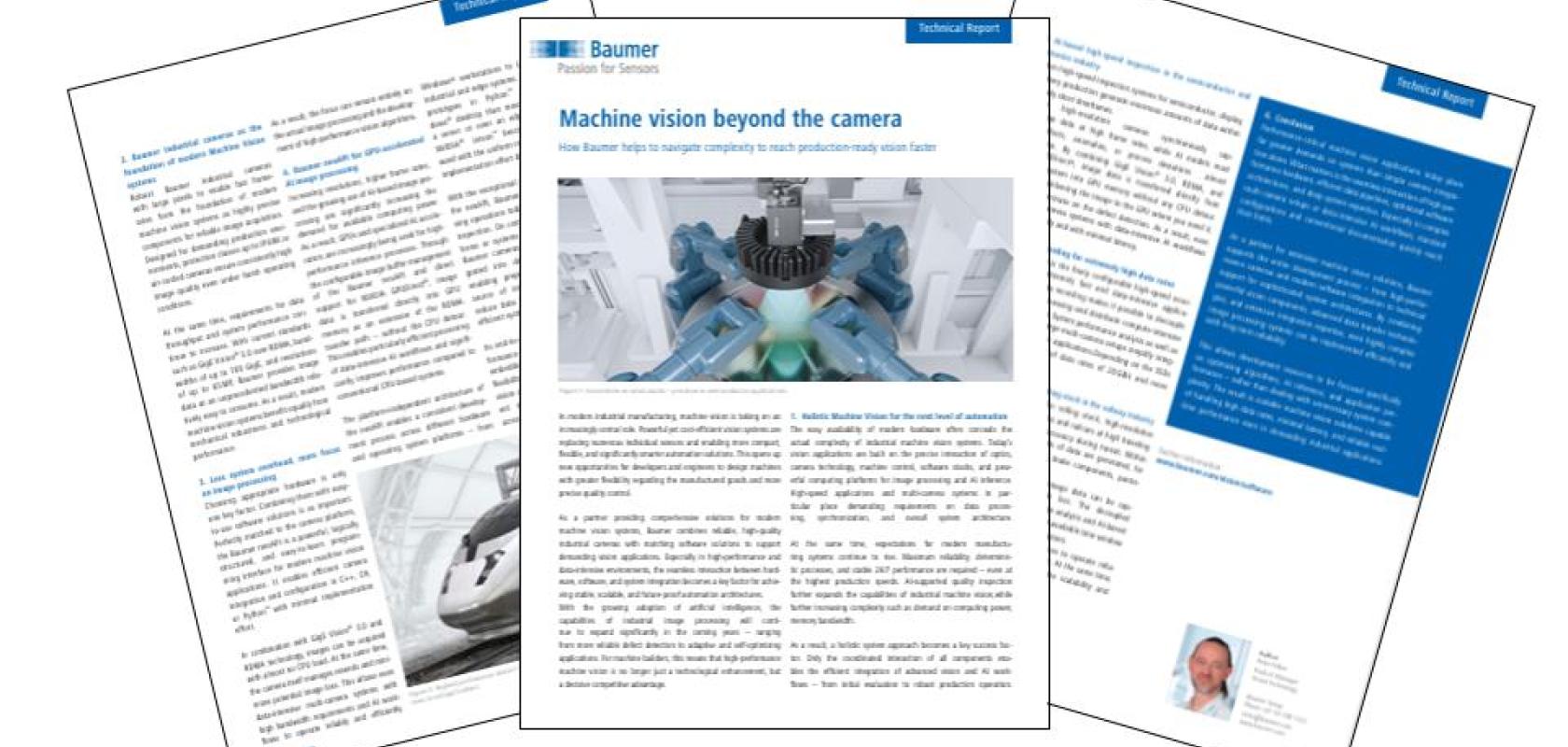
Navigating the complexity of modern high-performance machine vision systems - A Baumer White Paper
Modern industrial manufacturing has reached a critical inflection point. Machine vision is no longer a peripheral sensor technology - it's become a central pillar of competitive advantage, replacing dozens of individual sensors whilst enabling more compact and significantly smarter automation systems. Yet the easy availability of powerful camera hardware conceals a profound truth: the complexity of deploying production-ready vision systems extends far beyond selecting the right camera.
Today's demanding applications: high-speed semiconductor inspection generating terabytes per minute, AI-powered defect detection running on edge devices, real-time multi-camera systems synchronised across complex production lines; need seamless interaction between optics, hardware, software architectures, data pipelines and AI inference engines. A mismatch in any single component cascades through the entire system, introducing latency, data loss, synchronisation failures and ultimately, unacceptable downtime.
This White Paper demystifies the hidden complexities of modern machine vision systems, showing how the coordinated interaction of all components - from industrial cameras and advanced data transfer protocols to GPU-accelerated software - transforms theoretical performance into reliable production operation.
Who should read this White Paper?
This resource is designed for:
- Machine builders and OEMs designing vision-based quality control systems across industries
- Vision system integrators configuring multi-camera setups for high-speed or data-intensive applications
- Automation engineers implementing AI-based inspection for semiconductor, electronics or manufacturing environments
- Technical decision-makers evaluating whether existing systems can handle emerging demands like GPU acceleration and edge processing
What you'll discover
The paper covers the complete machine vision ecosystem, starting with the foundational role of industrial cameras before exploring how software, data transfer and AI acceleration work together to eliminate complexity.
Key topics include:
Industrial cameras as the foundation: how large-pixel designs, protection classes up to IP69K, and bandwidth standards like GigE Vision 3.0 over RDMA provide the base layer for reliable systems
Software that eliminates overhead: the Baumer neoAPI enabling efficient camera integration in C++, C# and Python with minimal implementation effort, plus almost-zero CPU load acquisition using RDMA technology
GPU-accelerated AI workflows: direct image transfer from cameras into GPU memory via NVIDIA GPUDirect without CPU detours, enabling data-intensive inference at production speeds
Platform-independent scalability: building prototypes on Windows desktops in Python, then scaling to edge platforms like NVIDIA Jetson or ARM-based systems with the same unified neoAPI architecture
High-speed recording for peak-load decoupling: capturing continuous data streams at 20+ GB/s whilst decoupling analysis from acquisition to avoid bottlenecks
Real-world applications: semiconductor and display production detecting process deviations in real time, plus railway inspection systems capturing detailed defect analysis of rolling stock at transit speeds
Why this matters for your operations
Standard camera documentation and conventional configurations reach their limits quickly when facing multi-camera synchronisation, GPU acceleration or edge deployment. The result is that engineering teams waste resources solving integration problems rather than optimising algorithms and inference performance.
By explaining how holistic system design - matching hardware capabilities, software architecture and data transfer protocols - eliminates unnecessary complexity, this White Paper demonstrates how even highly demanding applications can be implemented efficiently with long-term reliability and scalability.
Download the White Paper now to learn how leading manufacturers overcome vision system complexity and deploy AI-powered inspection at production speed.