Ahead of a pending company expansion into Europe with a new office in France, REVOX is using VISION 2026 to challenge a familiar assumption in machine vision: that the camera is the primary determinant of what an inspection system can see. As applications shift towards hyperspectral imaging, AI and multi-modal sensing, the Japanese company argues that the more fundamental question is what information the illumination puts in front of the sensor in the first place.
It is starting to capture our attention, but there is an uncomfortable truth at the heart of machine vision: a better camera does not necessarily mean a better inspection system. We know a sensor can have higher resolution, greater sensitivity and faster frame rates, but if the illumination does not expose the feature being inspected, none of those specifications matter.
That is the argument REVOX will take to VISION 2026, where it is putting UV-to-SWIR illumination at the centre of its offering for hyperspectral and high-speed imaging. “Cameras do not capture objects directly. They capture reflected light,” said company owner Hidehiro Kamada. “Therefore, illumination determines what information becomes visible and what remains hidden.”
It is a deceptively simple proposition, but one that becomes more important as machine vision moves beyond conventional surface inspection. For decades, visible-light imaging has been good enough for many inspection applications, but manufacturers are increasingly being asked to identify differences between materials, detect structures beneath surfaces and find defects that do not produce an obvious contrast in the visible spectrum. It’s becoming clear that simply adding more pixels is not necessarily the answer.
REVOX's pitch is that machine vision needs to move beyond the assumption that more powerful visible-light imaging will solve every inspection problem. Different wavelengths expose different physical characteristics and visible light can provide strong information about surface appearance, colour and texture, while NIR and SWIR can reveal material differences, hidden structures and features that are effectively invisible to conventional cameras operating in the visible spectrum. That makes illumination a much more strategic component of the imaging architecture.
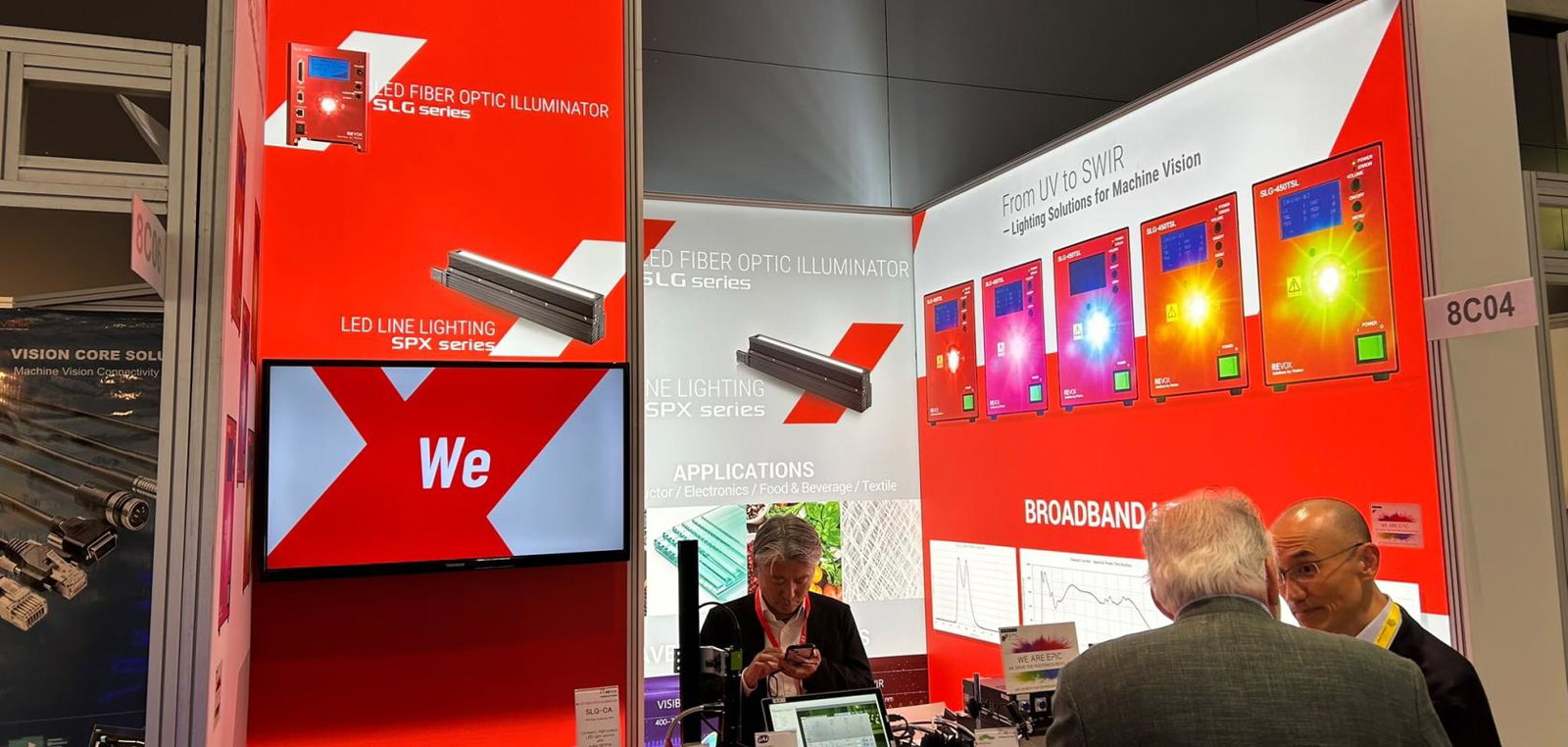
REVOX is not attending VISION 2026 with a conventional product-launch approach. Instead, it is showcasing what it describes as a broadband and multi-wavelength LED strategy that is designed to give system developers more control over the spectral information reaching the camera. The company's LED manufacturing capability spans wavelengths from 235nm to 1900nm, covering UV through visible, NIR and SWIR.
At VISION 2026, this will translate into demonstrations and technologies covering broadband LED concepts, multi-wavelength LED modules, custom UV-to-SWIR illumination platforms and high-brightness lighting for high-speed imaging.
The direction is significant because it changes the question developers need to ask. Rather than simply asking how much light do we need, the question becomes what wavelength of light do we need to see the feature we care about?
Breaking away from the catalogue
REVOX also sees an opportunity to differentiate itself from a lighting market in which much of the underlying technology is based on commercially available LEDs. “Most lighting suppliers select LEDs from existing commercial catalogues,” said Kamada-san. “REVOX takes a different approach.”
The company manufactures LED devices in-house and combines LED development with optical, thermal, electronic, software and FPGA engineering. That vertical integration is intended to give REVOX control over the characteristics that ultimately determine whether an illumination system works in a demanding inspection environment.
Wavelength is only one part of the equation. Brightness, response speed, thermal stability, packaging, optical design and the way the illumination is controlled all influence the resulting image. The company says it can optimise these elements together because it controls the LED development process, from die bonding and wire bonding through to phosphor engineering, packaging and quality inspection. That also allows it to address applications that may be too specialised for the conventional high-volume LED supply chain.
REVOX cites custom wavelengths, broadband spectra, high-density chip-on-board (COB) configurations and low-volume specialist projects among the applications where this approach can be particularly relevant. For machine vision OEMs, this could matter as systems become increasingly application-specific – the industry is moving away from a model in which a camera, lens and standard lighting arrangement can be combined into a largely generic inspection platform. Increasingly, the imaging architecture has to be designed around the material and defect being inspected.
Because REVOX manufactures their own LED modules in-house, they maintain the ability to control processes, perform faster coding, and customise wavelengths based on customer requests.
Hyperspectral imaging makes this issue particularly difficult to ignore. A conventional machine vision system might be optimised to maximise contrast in a relatively narrow part of the spectrum. Hyperspectral imaging instead seeks to extract information across multiple wavelengths, potentially allowing algorithms to distinguish materials or physical characteristics that appear almost identical in a conventional image.
However there is little point in building an increasingly sophisticated hyperspectral imaging architecture if the illumination does not deliver useful spectral information to the sensor. This is where REVOX sees its UV-to-SWIR capability becoming relevant.
“In our 20 years as a company, we have sustained long-term relationships and focused on line scan cameras, UV, visible light, near-infrared, and hyperspectral imaging,” said Kamada-san. “For example, our SPX-iBC ranges from 400 nanometres to 1000 nanometres. This tunable broadband LED lighting system is ideal for hyperspectral imaging.
“We realised that we could find success by applying this in place of traditional halogen lighting.”
The company is effectively positioning illumination as part of the sensing system rather than as a supporting component.
That distinction could become increasingly important as AI is brought into industrial inspection. AI can identify patterns that would be difficult to define using conventional rule-based vision algorithms, but it cannot manufacture physical information that was never captured by the sensor. If two materials produce effectively indistinguishable signals under a particular illumination condition, increasingly sophisticated image processing does not automatically resolve the problem, but changing the illumination may.
REVOX wants to use the Stuttgart show to explore if the machine vision industry is asking the wrong question when it treats illumination primarily as a way of making an image brighter. “The future of machine vision is not simply about capturing brighter images,” Kamada-san said. “It is about acquiring more meaningful information.”
That distinction is becoming more relevant as inspection moves towards AI, hyperspectral imaging and multi-modal sensing. The result could be a gradual move away from fixed, single-wavelength illumination towards systems capable of selecting or combining wavelengths according to the inspection task. REVOX describes the direction as a move towards multi-wavelength imaging, broadband illumination, adaptive lighting and hyperspectral image acquisition.
Whether that becomes mainstream across machine vision remains to be seen, but the underlying engineering argument is difficult to dismiss: illumination is not simply there to make the camera's job easier. It determines what the camera has a chance of seeing in the first place. For system developers visiting VISION 2026, that puts the spotlight on a component that can sometimes be treated as an afterthought.
The camera may still be the part of a machine vision system that gets the specification headlines, but if REVOX is right, the competitive advantage increasingly could be determined by what happens before the photons ever reach it.
By expanding into Europe, REVOX aims to take advantage of the potential for relationships with a greater array of camera manufacturers. “Hyperspectral camera quantity for shipping is ten times that of the Japanese market,” said Kamada-san. “Besides this, along with large companies like Bosch, Philips and Siemens, there are many excellent smaller companies supporting these entities, allowing us to contribute effectively to European industries.”