
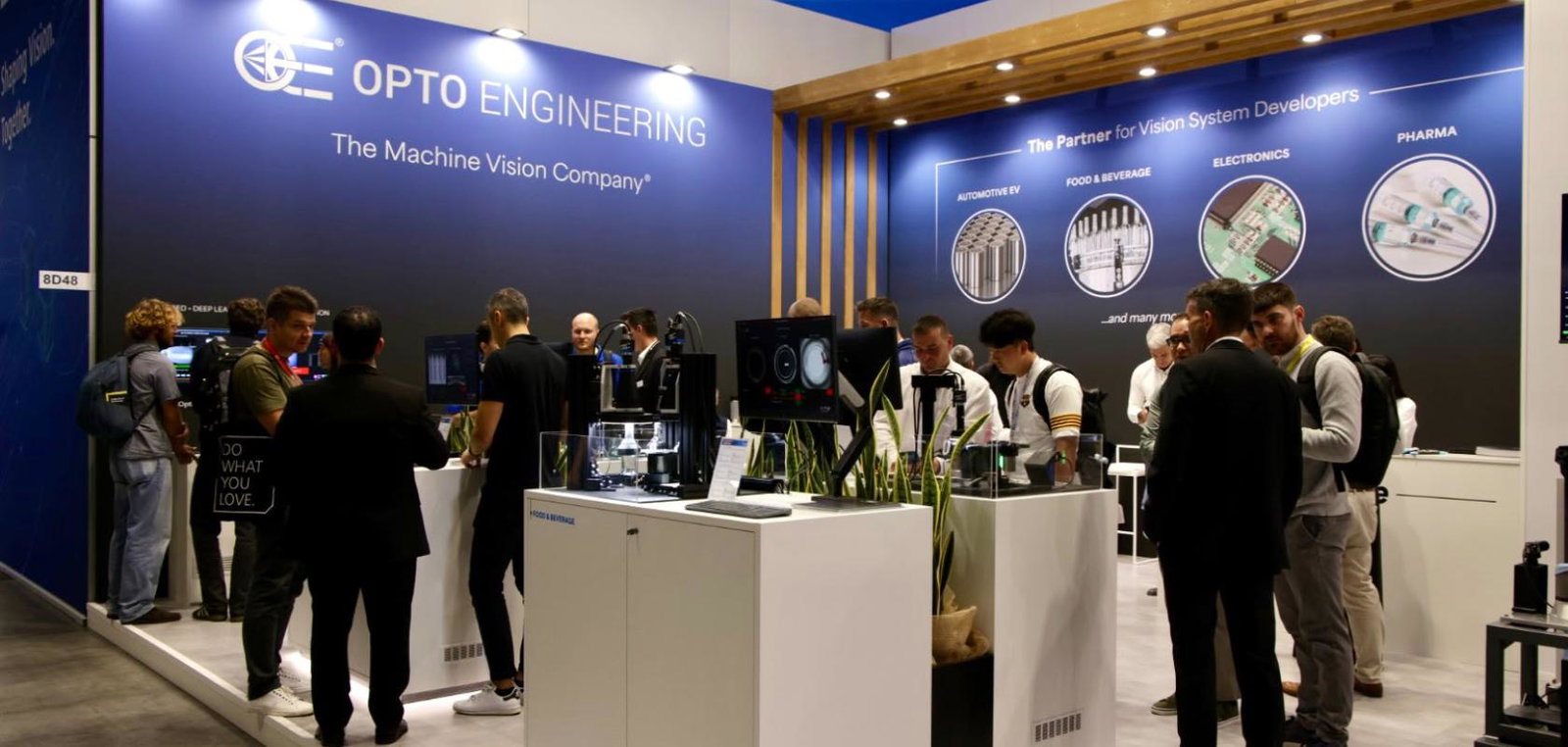
Opto Engineering used this year’s VISION to demonstrate its full capabilities as a machine vision partner. Valeria Siesto, Head of Marketing and Product Strategy, said: “We designed our booth as a journey through real machine vision applications: not abstract concepts, but the actual challenges our customers face on their production lines, and how vision solves them.”
According to Siesto, this reflects the role Opto Engineering wants to play in the market. “We do not see ourselves simply as a component supplier,” she says, “but as a technology partner that’s capable of working alongside customers throughout the application development process, from understanding the initial requirement to identifying the most appropriate vision solution.”
As well as strengthening the partnership aspect, the team also used the event to offer a first glimpse of its next generation of products. “We are working on a new technology that will extend the boundaries of machine vision even further,” explains Siesto. “We’re not
revealing what it is yet, but selected customers had the opportunity to discover more during the show.”
One area of focus that was available for all to see was the OEVIS Deep Learning platform. “This is our approach to bringing industrial AI into machine vision applications without requiring coding expertise,” says Siesto. “The platform leverages advanced neural networks to extend what our customers can inspect beyond the scope of rule-based vision alone, addressing cases where products, defects or production conditions present a high degree of variability.
“What makes it different is the simplicity you can actually see. There are three guided steps: dataset, train, evaluate. You see every data augmentation before you train and every result after it, down to the single image. Then you deploy in OEVIS, right next to your rule-based tools – no code, no data scientist needed!”
“OEVIS Deep Learning represents a broader direction for Opto Engineering. Our objective is to solve the customer’s vision problem, selecting and combining the technologies that best fit the application rather than approaching the market from the perspective of individual components.”
So, what sets Opto Engineering apart? “We develop and manufacture all the key elements of a machine vision system in-house,” explains Siesto. “Optics, lighting, cameras and software are all engineered by our own internal R&D. For customers, that translates into a very practical advantage. When an application goes beyond standard technical support, we can bring direct product and engineering expertise into the discussion, which is something we hear constantly from customers as a real differentiator.
“That depth of knowledge is also what enables us to offer customers something harder to find elsewhere: true systemic engineering consultancy. This capability is especially relevant in multidisciplinary applications with high operational criticality, where selecting a component from a catalogue is rarely enough. In those situations, understanding exactly how each component performs and, more importantly, how they perform together, becomes essential.”
Opto Engineering had previously built its reputation as a specialist in telecentric optics and, while that expertise remains a core strength, it is now surrounded by expertise in other areas too. “We’re bringing that same depth of engineering to our cameras and software as well,” explains Siesto, “so customers get that same integrated, all-in-one approach across the entire vision system.
“From a market perspective, the real differentiator is not simply having all these technologies in our portfolio. It is the ability to bring them together around the application and give customers one coherent approach to solving their vision challenge.”
Beyond the technology, Opto Engineering is also revolutionising its customer-centric approach. “We are becoming much more systematic in the way we capture market insights, translate customer requirements into product and application priorities, and design the overall customer experience,” says Siesto. “For us, being customer-centric cannot simply be a statement of intent. It has to influence how we develop applications, how we provide support and, ultimately, how we interact with customers.
“This connects directly to our idea of ‘Extending what’s possible’. We don’t see that concept only as a commitment to innovation, but also as a way of continuously improving how we work with our customers. And, soon, something new entering the market will give that idea an even more tangible meaning – extending further what our customers can achieve with machine vision.”
There are exciting times ahead for Opto Engineering – so watch this space!