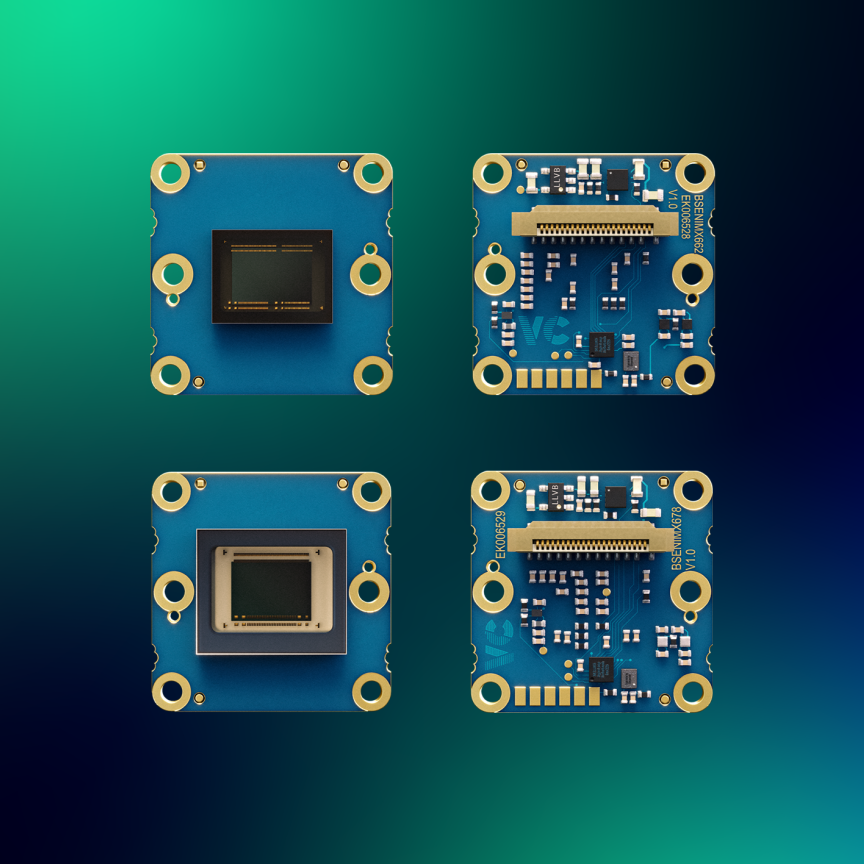
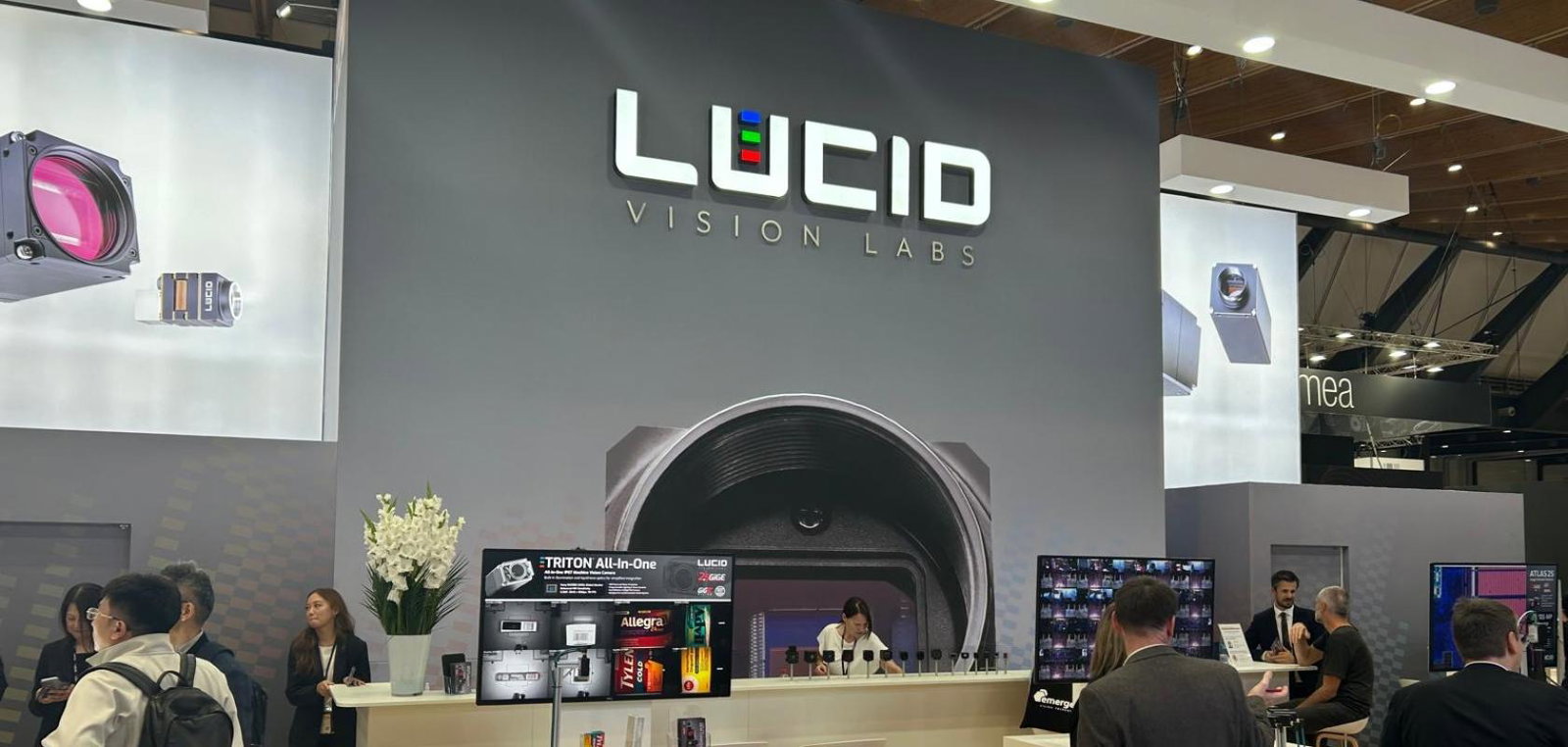
The Lucid Vision Labs booth was packed with new products at the VISION 2026 show, with three demonstrations in particular catching the eye of visitors.
Alexis Teissie, Director of Product Management, explained the first of these, which featured the Atlas25 25GigE RDMA camera, incorporating the 105MP IMX937 global shutter sensor from Sony. “In this demo, we are using the Atlas25’s TFL-II lens mount to connect to a telecentric lens with integrated lighting via a TFL-II to F-mount adapter,” said Teissie. “The platform is passively-cooled, so no moving parts, which extends the temperature range.
“One of the things we did was adapt the Lucid active alignment system. Setting up that alignment before you mount the sensor on the PCB is especially important with a larger sensor, since a small variation in alignment can translate to a much higher displacement at the end of the process.”
While the demo showcased the system working with PCBs, the system is suitable for any application requiring high throughput, high resolution and high pixel count, such as semiconductors.
This latest large format model enables customers to employ fewer cameras. “Instead of scanning different parts of a larger object,” explains Teissie, “you can do them all at once. Or, you can have much higher precision in the same working area footprint.
“We see 25GigE as the ‘sweet spot' in terms of cost performance, particularly as it can be used with fairly standard general purpose networking equipment, rather than requiring specialist vision connectivity.”
The next demo showcased 20 Triton10 10GigE cameras streaming simultaneously to a single host using GigE Vision 3.0 RDMA, demonstrating zero-copy image transfer directly into GPU-accessible memory.
“Lucid was one of the early adopters of RDMA [Remote Direct Memory Access] in the vision industry,” explained Teissie. “Now, we’ve not just proved that it works, but we’re actively looking at how we use it to scale up.
“A key challenge was not just getting the data into the system, but how you synchronise the cameras without using a lot of cabling. So, we developed the eTrigger firmware feature, to provide Ethernet-based real-time synchronisation. In this, one camera receives a single hardware trigger signal, then all cameras share a common time base. This enables us to schedule a future action command without relying on firmware processing.”
The typical uses for this kind of set-up might include any application looking at large objects in automotive manufacturing or large infrastructure, such as tunnels.
The final highlighted demonstration showcased the Triton All-In-One, featuring built-in liquid lens and illumination. “We recognised that many customers working in factory environments will need to deploy optics and cabling along with their cameras,” said Teissie. ‘So, we took the step of integrating all of that in one product, with programmable lighting and lens focus controls.”
The system includes a 2.5GigE camera and a 3.2MP Sony IMX900 sensor, offering NIR sensitivity, which will be suitable for many standard applications. “Existing machine vision users will no longer have to source the illumination and optics separately,” says Teissie. “The system still has the flexibility to be adapted – you still have fine control of illumination options, for example – but it can also be paired with an external illumination source in cases where required.
“Similarly, the tunable liquid lens allows you to adapt to the different heights and shapes of objects that may be encountered frame to frame. The lenses have a very long life cycle compared to a standard mechanical solution. It allows for swift changes between product variations on a production line and is much easier to maintain without a service visit.”
Lucid has clearly applied its deep knowledge of the industry to create this easy-to-use, yet flexible, system, which according to Teissie, created a lot of interest at the show.