
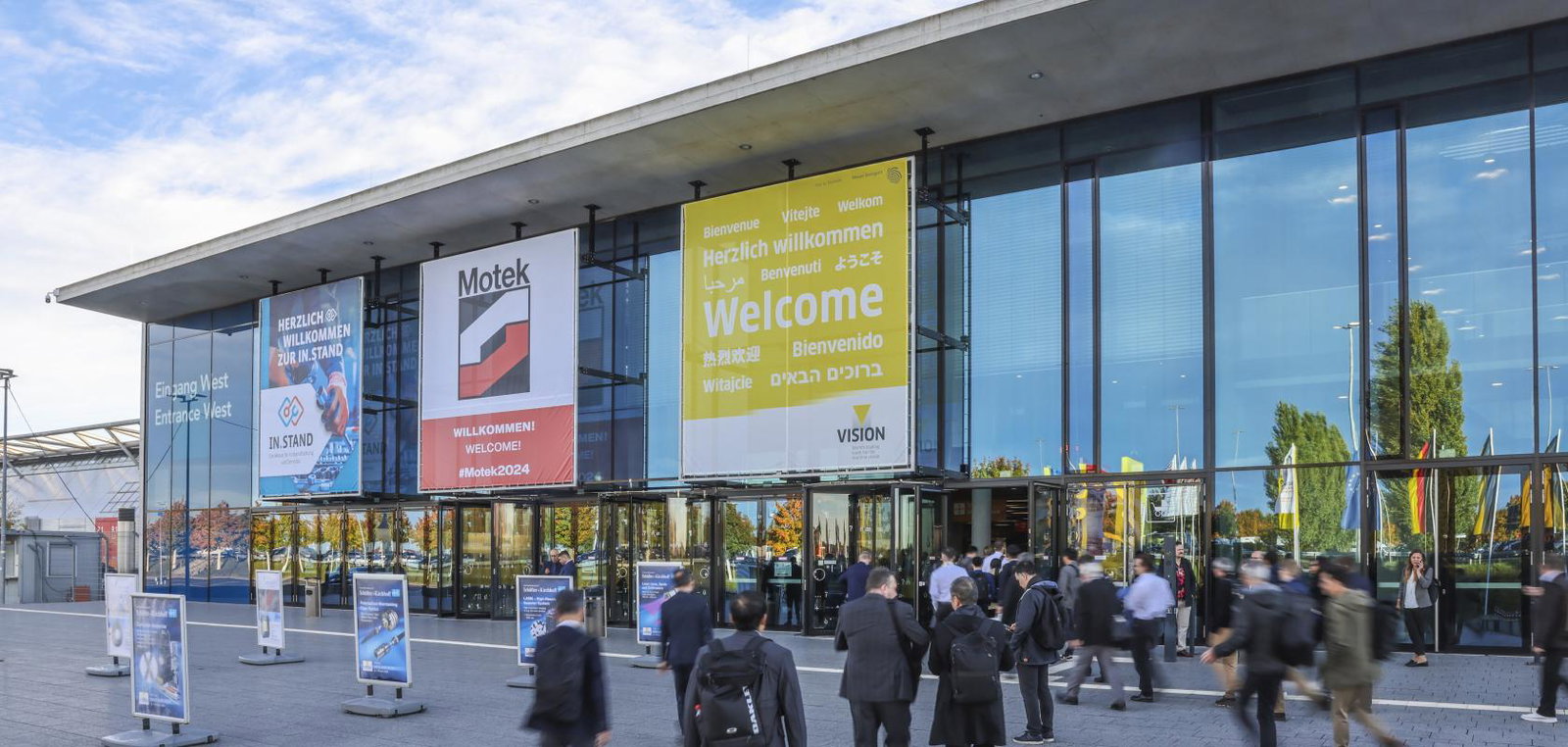
From pixel-level HDR and hyperspectral sensing to SPAD cameras, adaptive optics and photon fusion, these are the five startups that will outline new approaches to machine vision at day one of VISION 2026.
Now the Messe Stuttgart doors have finally opened for VISION 2026, the machine vision industry will have plenty of familiar names and technologies to investigate. But one of the most interesting places to look for what comes next will be the week’s Start-up Sessions.
Startups matter to an industry such as machine vision because they can work on problems that sit between established technology categories. A new approach to an image sensor can change what a camera can capture; a different optical architecture can alter how a system is designed and new processing methods can change what can be extracted from the resulting data.
That makes startup programmes at major industry events particularly useful for engineers and system designers. These are the real innovators at the forefront of the market, inspiring the bigger players to aim high, not just with advances in technology, but in commercial viability, as well.
With five fresh-faced companies featured during a dedicated Start-Up Session each day, here’s a look at what you can expect on day one:

A full programme of Lecture Forums across Industrial and Scientific VISION Days will be amongst the many offerings for visitors to VISION Stuttgart (Image: Messe Stuttgart)
EYE-TECH: putting HDR into the pixel
EYE-TECH is approaching one of the most persistent sensor-level machine vision problems: how to capture scenes containing large differences in illumination without introducing the artifacts associated with conventional HDR (High Dynamic Range) techniques.
The presentation, ‘Real Global Shutter with HDR at pixel-level for Next-Gen CMOS Sensors’, given by EYE-TECH’s Monica Vatteroni, will centre on EYE2DRIVE, a pixel-level architecture developed to provide native single-frame global-shutter HDR. The company describes it as a linear pixel architecture with conditioning circuitry that dynamically adjusts charge discharge and pixel sensitivity according to incident light.
The distinction is key for high-speed vision to work. Conventional multi-exposure HDR can create motion artifacts because different parts of an image are captured at different moments, but EYE-TECH says its approach will produce HDR in a single exposure, while retaining a global-shutter architecture.
The attraction for integrators and system designers is therefore not simply greater dynamic range, it’s the possibility of handling difficult lighting conditions at the sensor without relying on multi-frame fusion or adding HDR processing downstream.
HylasVision: making material information visible
VTT LaunchPad spin-off HylasVision is developing a system that the company says identifies materials from their spectral signatures, with stated applications including automated plastic, food and textile sorting.
The ‘HylasVision is bringing a new standard for material sensing’ presentation from Jussi Soukkamaki will discuss a significant challenge within hyperspectral machine vision: that the specialist cameras and optical architectures required by some conventional machine vision systems can make them too complex for industrial deployment.
To combat this issue, HylasVision's approach changes where the spectral separation takes place. Rather than separating wavelengths inside the camera, the company's technology uses a fast hyperspectral laser source to provide the spectral information. VTT says, by simplifying the imaging architecture, the solution could allow a conventional camera to be used as a spectral camera.
The main target application for HylasVision is robotic sorting, particularly where the requirement is to identify a material, rather than just locate or classify an object.
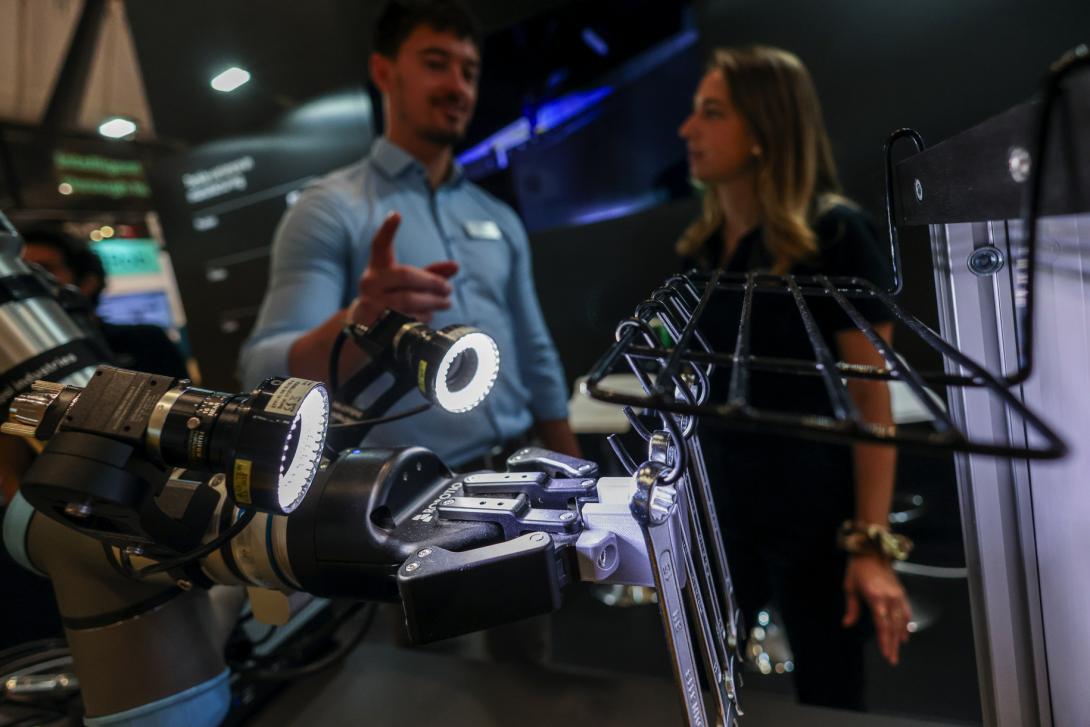
The latest integrated cameras and industrial lighting systems will be on show on the exhibition floor (Image: Messe Stuttgart)
NovoViz: taking SPAD cameras into industrial vision
SPAD technology is another way to change what a machine vision camera can capture. The presentation ‘From Visible to SWIR: SPAD Cameras for Industrial Machine Vision’, from NovoViz’s Utku Karaca, focuses on single-photon avalanche diode sensing and its potential across the visible and short-wave infrared.
NovoViz develops SPAD sensors and camera systems, including a variable-frame-rate camera with event-based readout, global shutter and on-chip pixel binning. The camera’s architecture records photon events rather than simply producing conventional frame data, with adjustable event thresholds and nanosecond-level timing.
According to NovoViz, that opens up an interesting combination for machine vision: SPAD-level sensitivity and very fast acquisition alongside event-driven data output. NovoViz says its variable-frame-rate camera is aimed at applications including machine vision, low-light imaging and visual odometry.
The underlying shift is from treating an image as a fixed sequence of charge-integrated frames to using individual photon detections as the raw measurement. And that could offer another way to approach both high-speed and low-light imaging, while still reducing the volume of data leaving the sensor.
Phaseform: putting adaptive optics under algorithmic control
The next presentation, ‘Algorithm-Driven Optics: 63 Degrees of Freedom for AI-Controlled Imaging’, moves the discussion from the sensor to the optical path.
The Freiburg-based company has developed a Deformable Phase Plate (DPP), a transmissive wavefront modulator with 63 independently controlled degrees of freedom. Rather than relying entirely on fixed lens elements to correct aberrations, the DPP allows the optical wavefront to be modified electronically after assembly and during operation.
According to Phaseform, that has particular implications for compact machine vision systems. The company describes applications in which field-dependent aberrations can be corrected in the region of the image, potentially allowing optical designers to rethink some of the previous compromises made between lens complexity, tolerances and field performance.
The presentation will be delivered by Phaseform CTO and Co-Founder, and a Photonics100 honouree, Dr Pouya Rajaeipour, who will explain what happens when those 63 optical degrees of freedom are controlled by an algorithm.
Ubicept: turning individual photons into perception
Ubicept is approaching the SPAD problem from a different direction. Its presentation, ‘Single-Photon Vision: From Raw Data to Industrial Perception’ last up on the Industrial VISION Days stage from Sebastian Bauer, focuses on what happens after individual photons have been detected.
SPAD sensors can provide extremely precise information about photon arrival, but their raw output is sparse and high in bandwidth, and conventional image-processing pipelines are not necessarily designed for this type of data. Ubicept says its technology is aimed at converting those measurements into images and other perception-ready information formats.
The company's Ubicept Photon Fusion (UPF) processing uses a physics-based approach to reconstruct visual information from sparse or noisy measurements over time. The company positions this as a way of addressing the fundamental trade-offs between motion blur, noise and dynamic range that affect conventional cameras.
For engineers, integrators and buyers walking the halls of Messe Stuttgart this week, the three Start-up Sessions offer a relatively concentrated way to see multiple attempts to change common assumptions from the inside out.
Stay tuned to Imaging & Machine Vision Europe for Day 2’s Start-up highlights on Wednesday 07 October.