

As industrial vision systems continue to evolve, the demands being placed on imaging optics are becoming increasingly challenging. Higher-resolution cameras, new sensor formats and demanding operating environments mean that selecting a lens is not simply a matter of matching a camera mount and focal length. For Resolve Optics, VISION 2026 provides an opportunity to demonstrate why application-optimised optical design is becoming increasingly important – and to unveil a new radiation-tolerant HD lens designed for the latest generation of CMOS imaging systems.
Resolve Optics has traditionally supplied radiation-tolerant lenses for demanding applications in the nuclear power and space industries. These sectors have historically relied on relatively low-resolution tube cameras for monitoring, but the increasing adoption of CMOS sensors is changing the requirements placed on optical systems. “With new high-resolution cameras and sensors appearing almost weekly, it is becoming increasingly rare to find a standard format device,” says Rob Watkinson, Sales Manager at Resolve Optics. “Consequently, sourcing a lens optimised for your vision application has never been more critical.”
At VISION 2026, Resolve Optics showcases its new 419 model, a 9mm f/2 radiation-tolerant HD lens, for the first time. The fixed-focus lens has been developed to meet the higher-resolution demands of CMOS-based radiation-resistant camera systems, with additional focal lengths soon to follow. The new lens illustrates the company’s customer focused approach: rather than treating the lens as a standard component selected after the camera and sensor have been specified, Resolve Optics works to optimise the complete optical solution around the application.
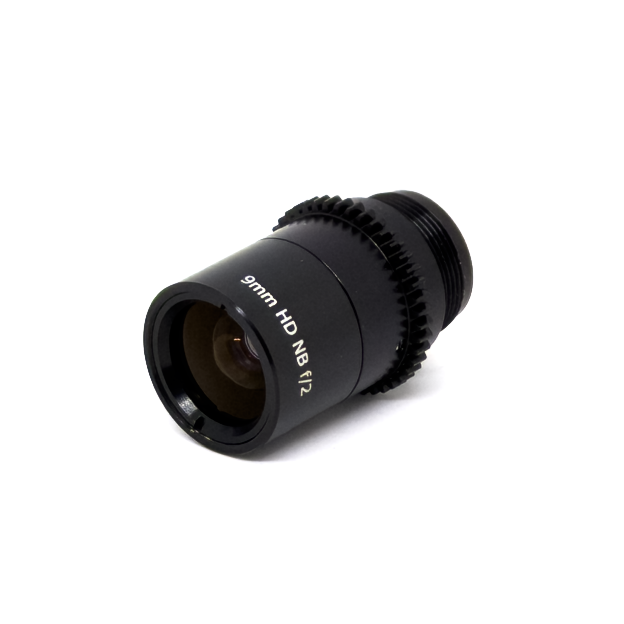
Resolve Optics showcases its new 419 model, a 9mm f/2 radiation-tolerant HD lens at VISION 2026
The company’s experience spans nuclear, space, defence, aerospace, industrial and medical applications and, in that time, it has realised conventional catalogue optics will not always provide the required combination of performance, environmental resistance, size or availability. “Industrial vision is a rapidly evolving technology area,” Watkinson explains. That pace of development is speeding up: “With new high-resolution cameras and sensors appearing almost weekly, it is becoming increasingly rare to find a standard format device.”
Resolve Optics can design optimised lenses around factors including working distance, wavelength range, camera mount and sensor format. Designs can also be developed to provide wide fields of view with little or no distortion, or to meet strict space constraints where a conventional lens would be too large.
For demanding environments, application-optimised lenses can be athermalised and ruggedised, and this allows the optical system to maintain its performance through temperature variations and withstand harsh operating conditions. The approach is particularly relevant as machine vision moves into applications where image quality has consequences beyond simply producing a visually clear image. Lens performance can influence measurement accuracy, operating reliability, reproducibility and the quality of downstream image analysis. The objective, therefore, is not simply to produce an image, but to ensure that the optical system is properly matched to the demands of the complete vision application.
When does bespoke make sense?
Resolve Optics is not suggesting that every vision system requires a custom lens. Where an off-the-shelf product meets all the requirements of an application, the company recommends using it, but the case for a bespoke solution arises when a standard product cannot provide the required combination of characteristics. This could be because of a harsh environment, restricted installation space, an unusual sensor format or other application-specific requirements.
There is another consideration for OEMs: product longevity. An off-the-shelf lens can potentially be discontinued, leaving a camera manufacturer with the challenge of identifying and qualifying a replacement. Resolve Optics offers guaranteed security of supply for its application-optimised lenses, with products designed and manufactured for customers remaining available for as long as they are required.
Where appropriate, the company can also offer design exclusivity, preventing other customers from purchasing the same lens and potentially giving an OEM a competitive advantage.
A recent project demonstrates how application-optimised development can also reduce development times. “Resolve Optics was approached by a satellite camera core manufacturer requiring a new 6mm lens for use in space,” says Watkinson. “The lens needed to withstand prolonged radiation exposure, maintain consistent performance across a wide temperature range and survive the rigours of launch.”
With tight delivery requirements, developing a completely new optical design from scratch was not practical. Instead, Resolve Optics used the existing optical design of its 6mm fixed-focus radiation-tolerant nuclear lens as the starting point. The company redesigned the mechanics to create a space-ready version suitable for the customer’s camera core.
“This reuse of an established optical design enabled the new camera-optimised lens to be developed in a fraction of the time that would have been required for a completely new design,” says Watkinson. For OEMs working on demanding imaging projects, the example highlights an important advantage of working with an experienced specialist lens supplier - a bespoke solution does not necessarily mean starting from scratch.
Resolve Optics has more than 20 years' experience designing and supplying application-optimised lenses, working with customers internationally across a wide range of challenging applications. That experience is supported by using advanced optical manufacturing and CNC machining technology, enabling the company to deliver high-quality optical and mechanical components and assemble complete optical systems.
“When a customer approaches us with an enquiry, we draw upon decades of experience and designs to assess the best possible solution,” says Watkinson. “Our aim is to come back to the customer with a proposed design and estimate quote within just one to two weeks.”
The company's engineers have the experience and expertise to assess an application from the outset, considering the requirements of the sensor, camera, environment and installation rather than simply selecting a non-optimised lens from a catalogue. All lenses are also rigorously tested before leaving the factory to ensure reliability and complete customer satisfaction.
The message Resolve Optics is bringing to VISION 2026 is ultimately about the role of optics within increasingly sophisticated vision systems. As cameras and sensors continue to evolve, the assumption that a standard lens will always be the best match is becoming less sustainable. Unusual sensor formats, demanding working distances, specialised wavelength requirements, restricted packaging and harsh environments can all create situations in which the lens needs to be designed around the application.
For visitors to the show in Stuttgart, Germany, the new Model 419 provides a tangible example of that philosophy. Developed specifically to support the higher-resolution requirements of modern CMOS-based radiation-resistant imaging systems, the 9mm f/2 HD lens represents an extension of Resolve Optics' established expertise into the latest generation of industrial imaging. But the company sees the wider opportunity in going beyond off-the-shelf products.
Whether an OEM is developing a new optical product or looking to extend the life of an existing camera, sensor or instrument, Resolve Optics believes that designing the optics around the application's precise requirements can minimise compromises and deliver a more effective imaging solution. At VISION 2026, that means not just showcasing a new lens but demonstrating how specialist optical design can help machine vision developers solve problems that standard catalogue products cannot.
As Watkinson puts it: “We pride ourselves on offering fast honest advice.” For vision system developers facing increasingly specialised imaging requirements, that conversation could prove to be as critical as the lens itself.