
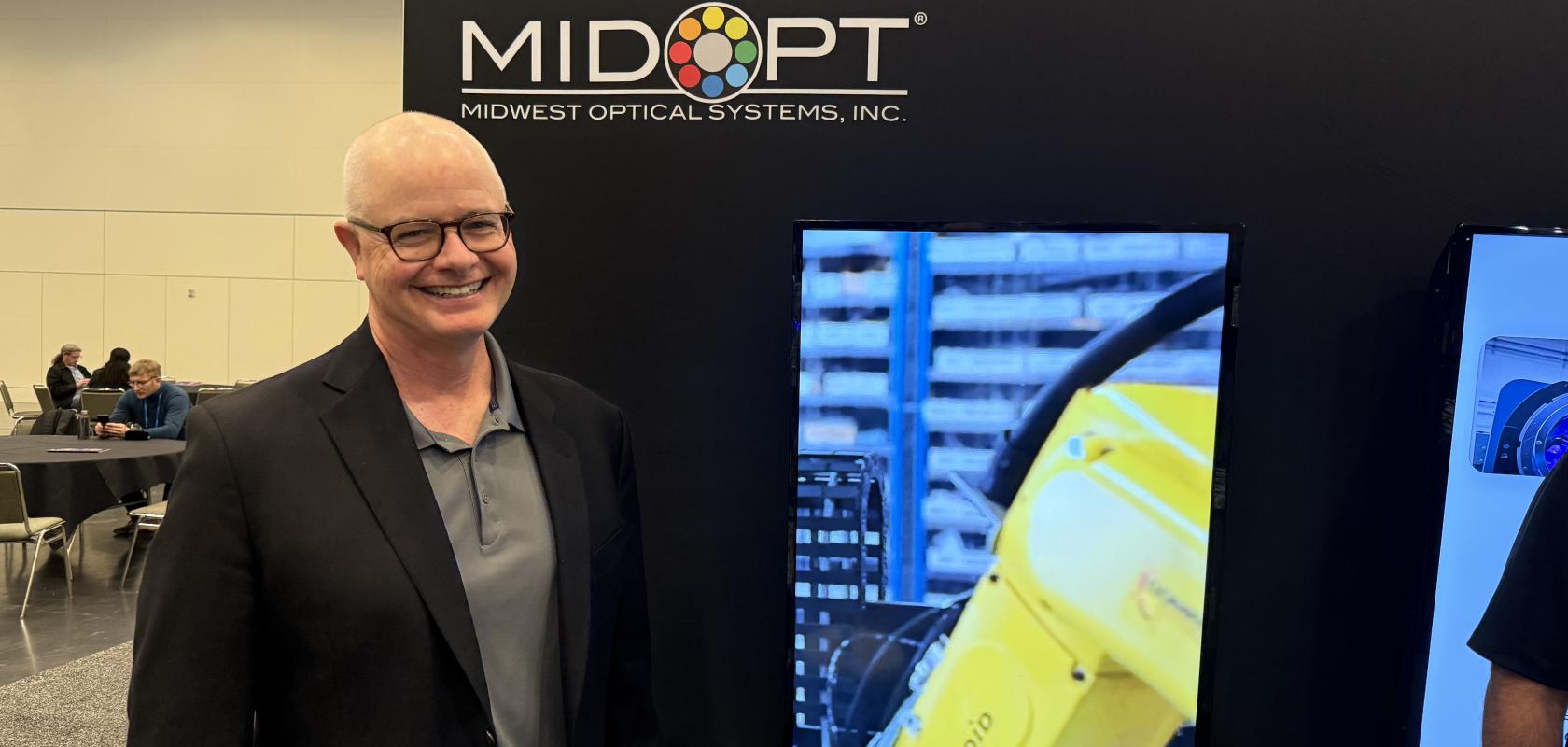
As machine vision systems grow more intelligent, autonomous, and widespread, the importance of optical fundamentals has not diminished – in fact, it has intensified. Midwest Optical Systems (MidOpt®), a long-established specialist in optical filters and imaging components, is demonstrating how deep expertise in light control remains essential to the performance, reliability, and scalability of modern vision systems.
Approaching its 40th year in business, MidOpt® continues to operate as a privately owned, family-run company, combining in-house manufacturing, custom engineering, and close customer collaboration to support demanding applications across industrial automation, logistics, autonomous systems, and beyond. “We’re owned by Barry Warzak and headquartered in Palatine, Illinois, with manufacturing both there and in Delavan, Wisconsin. Everything is very tightly integrated geographically,” says John Clarida, Director of Sales at MidOpt®.
With around 50 employees, MidOpt® occupies a distinctive position in the machine vision supply chain: large enough to support global OEMs and integrators, yet agile enough to respond quickly to highly specialised application requirements.
MidOpt® was built on optical filters, and that legacy continues to shape its role in the machine vision market. Clarida, who spent decades working in industrial automation and vision environments, recalls how embedded MidOpt® products were long before he joined the firm, says the company’s core focus remains discrete automation, where vision systems have transitioned from isolated inspection points to foundational elements of production lines.
“Fifteen years ago, vision was used on a few stations,” Clarida explains. “Now there’s hardly an application that doesn’t have a vision-based requirement.” This expansion has brought complexity. While cameras, processors, and AI algorithms have advanced rapidly, real-world variability continues to challenge system designers – keeping optical expertise firmly in demand.
According to Clarida, machine vision differs fundamentally from traditional automation in one key respect: predictability. “In traditional automation, if your mathematics were right, the solution would work every time,” he says. “In the machine vision world, you can get 90 percent there – but that last 10 percent is different.” That final margin is often where systems succeed or fail. Lighting artefacts, glare, spectral overlap, and insufficient contrast can undermine even the most advanced imaging platforms. The company’s role is to resolve these issues by controlling how light interacts with the scene and the sensor.
“At the core of what we do, machine vision is about creating contrast,” Clarida says. “So you can make a confident automated decision – yes or no, one or zero. Is the part there? Are the threads present in the hole?”
This philosophy underpins the firm’s long-standing tagline: ‘A necessity, not an accessory’. Optical components may be specified late in the design process, but they are often decisive.
“Customers will say, ‘I spent all this money on the camera, but I’m getting glare or poor contrast,’” Clarida notes. “They come to us, we provide a solution, they validate it – and suddenly the system works!”
Customisation as a core capability
Unlike high-volume optics suppliers, MidOpt® operates in what Clarida describes as a “high-variant, low-volume” environment, where customisation is routine rather than exceptional. “It’s not uncommon for a customer to order a part, then remove two features, then add them back and add two more,” he explains. “You end up with multiple revisions of the same component.”
Beyond filters, MidOpt® designs and manufactures a wide range of custom optical solutions, including protective windows for imaging systems. These can incorporate screen printing, branding, specialty coatings, precision tolerances, and integrated mounting features such as VHB tape. “A customer might want a clear aperture, a screen-printed surround, a logo, perimeter tape, waterproofing, and AR optimisation at a specific wavelength,” Clarida says. “We can do all of that in-house.”
Supporting this flexibility is a comprehensive internal infrastructure. MidOpt® maintains spectrophotometers for transmission and reflectivity verification, inspects scratch-dig and parallelism, and is ISO 9001:2015 certified. “We have the ability to test, validate, and manufacture what we say we’re delivering,” Clarida adds.
Despite the unpredictability inherent in machine vision demand, MidOpt® maintains significant inventory across its filter portfolio. This allows the company to respond quickly to both prototype and production requirements. “Most of what customers see on our website is available from inventory,” Clarida says. “If it’s a small quantity, perhaps 25 pieces or less, we can typically manufacture within two to three weeks.”
MidOpt® primarily sells through a global distribution network, providing local support while maintaining direct technical engagement when application complexity requires it. “There are situations where direct interaction makes sense because of the level of detail involved,” Clarida explains. “But overall, our distributor relationships are very strong.”
While North America remains the company’s largest market, international growth – particularly in Europe and Asia – is accelerating. “We’re seeing consistent global expansion,” Clarida says. “We invest heavily in shows, training events, and partner engagement worldwide.”
SiLWIR™: a strategic shift in LWIR
One of the company’s most significant recent developments is SiLWIR™, its silicon-based protective window for long-wave infrared (LWIR) imaging. The product was developed in response to supply-chain disruptions and cost volatility associated with germanium. “When germanium sourcing became nearly impossible, our leadership saw an opportunity,” Clarida explains. “We asked, ‘Why don’t we develop a silicon solution?’”
While silicon exhibits slightly lower transmission than germanium in LWIR – typically in the 80 per cent range versus low 90s – the practical imaging difference is minimal for many automation applications. “Even some of our largest customers have said that unless you’ve worked with germanium for years, you’d be hard-pressed to tell the difference,” Clarida says. “From an automation perspective, the images are extremely close.”
MidOpt® has supported SiLWIR™ with extensive internal testing, including drop-ball impact testing, comparative transmissivity data, and performance validation across multiple geometries and thicknesses. “We’re not just making claims,” Clarida emphasises. “We provide the data to back it up.”
In addition to performance consistency, SiLWIR™ offers improved availability, cost stability, and reduced supply risk—factors increasingly important to OEMs and system integrators. “The question customers have to answer is whether a few extra percentage points of transmission justify the added cost and uncertainty,” Clarida says.
Despite rapid advances in AI and imaging software, MidOpt® has not been displaced by technological change. Instead, it has reinforced its relevance by focusing on speed, adaptability, and optical fundamentals.
“Machine vision is still about creating reliable visual information,” Clarida concludes. “That’s why we’re still here after nearly 40 years – and why we continue to grow.”