Accurate colour reproduction is one of the most technically demanding challenges in industrial imaging. Unlike monochrome applications, colour imaging requires the entire imaging chain, from lighting and optics to sensor, software, and display, to work in harmony.
Here, we find out from Michael Steinicke, Product Manager at Baumer Optronic, how a structured understanding of colour fundamentals, combined with intelligent camera-based correction algorithms, is enabling reliable, repeatable colour imaging in demanding industrial environments.
Why colour is harder than it looks
For engineers moving into colour imaging from a background in monochrome machine vision, the first encounter with colour reproduction can be a shock. The experience and intuitions built up over years of greyscale work do not translate directly, and the gap between expectation and reality is often significant.
"In general this is driven by experience," says Steinicke. "Given the high proportion of monochrome applications and the experience gained with them, colour suddenly adds a whole new level of complexity, even for monochrome experts. Much of what is covered in our white paper must first be internalised and then put into practice."
Beyond the general complexity, Steinicke identifies specific points of confusion that recur frequently. "I think there are a few key points that people tend to stumble over. First of all, perhaps the visual impression when you compare beautifully manipulated mobile phone images with a real, industrial colour image. The correct use of gamma correction, which has a significant impact on the image, also plays a role here. Last but not least, the white balance must also be correct, of course."
White balance: The essential first step
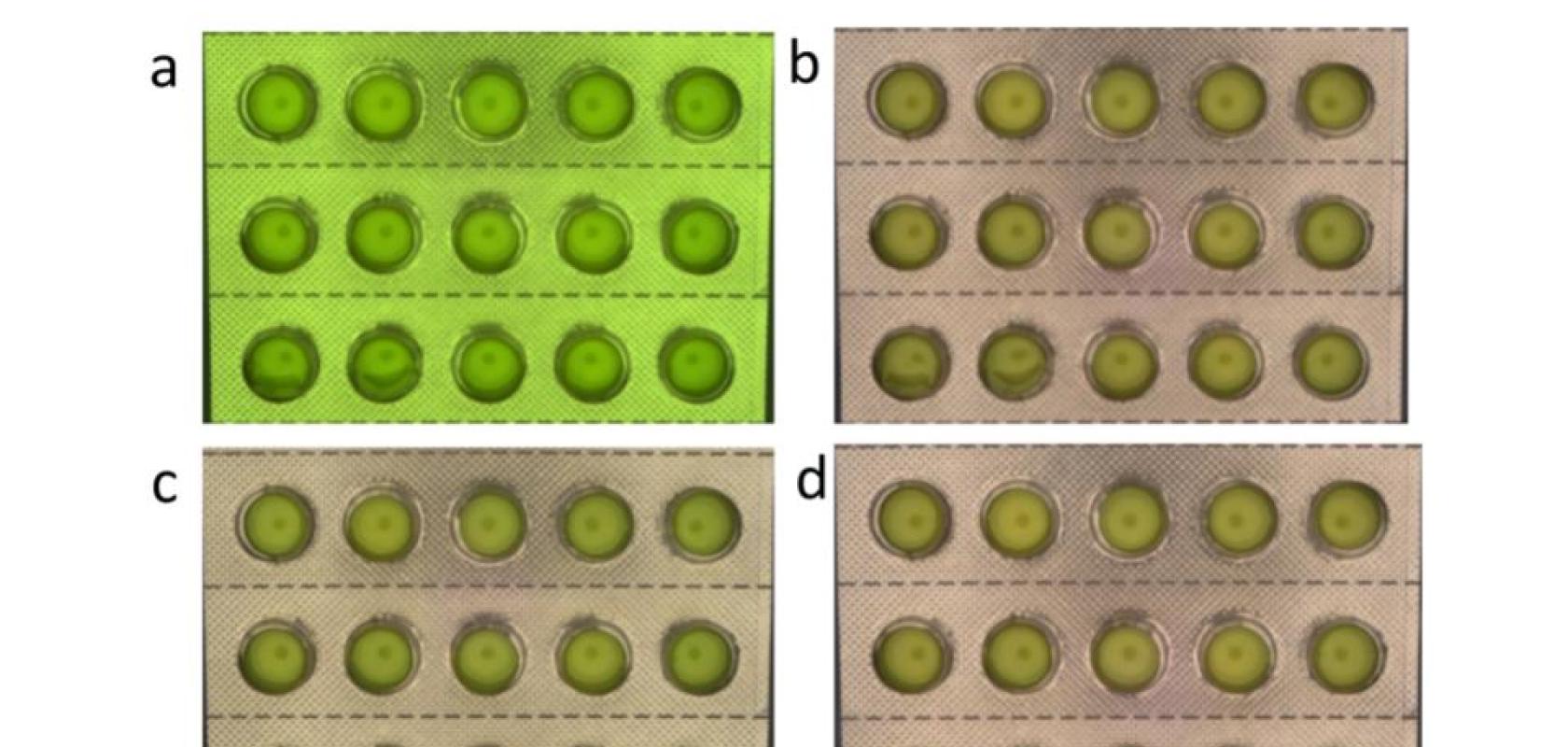
White balance adjusts the amplification factors of the red, green, and blue channels so that a neutral surface is rendered faithfully. In practice, this compensates for the specific spectral distribution of the light source. "White balance is often treated as a simple one-time setup step," Steinicke notes. However, real-world conditions frequently cause problems for engineers. "Foreign light can interfere with the white balance; very high temperature drift in systems can also cause the white balance to drift."
Baumer cameras are factory-calibrated to uniform intrinsic gain values, allowing fine-tuning to specific illumination without disturbing the base calibration.
Demosaicing: From raw data to colour image
Even after white balance, the raw output of a colour CMOS sensor is not a true colour image.
Demosaicing uses the Bayer pattern to reconstruct the colour channels missing from each pixel. "If you were to organise a hit parade of these influential factors, the winner would most likely be demosaicing," says Steinicke. "If incorrect colours are produced here, details are lost or homogeneous areas are disrupted, destroying the basis of the image—what could be worse?"
Baumer’s patented 5x5 algorithm draws more information from the pixel environment. "This results in fewer artefacts and colour errors, finer details and textures, more accurate colour reproduction, with adaptive noise reduction and edge sharpening," Steinicke explains.
Auto brightness and gamma: Handling with care
Auto brightness and gamma correction are often overlooked as sources of error. While auto brightness sounds convenient, industrial environments demand consistency. "It should only be used in cases where lighting conditions change: unavoidable influences from ambient light, reflections, or varying surface brightness," says Steinicke.
Gamma correction also requires careful thought when downstream processing is involved. "When looking at classic algorithmic image processing, a linear relationship between light and brightness is typically assumed," Steinicke explains. Using a gamma value other than 1 can shift the maximum gradient interpreted as an edge. "If measurements are then taken at the edges and the OK/NOK decision is based on this, the result may be incorrect".
Colour correction: The final piece of the puzzle
Even with correct white balance and demosaicing, the spectral sensitivities of a sensor do not perfectly match the human eye. This is resolved via a Colour Correction Matrix (CCM). Baumer’s colour correction ensures very high colour fidelity.
"The workflow is simplified because the cameras can select the appropriate colour correction for the colour temperature themselves, based on a patent-pending, intelligent functionality," says Steinicke. Correcting at the camera provides ease of use with a correct image in real time, rather than in post-processing.
"The camera already delivers the perfect image without having to deal with it on the PC," Steinicke notes. This FPGA-based calculation works in real time with little jitter and reduces system latency. Furthermore, the PC does not have to invest CPU and GPU power for this process, allowing it to focus exclusively on image evaluation. Where colour accuracy matters most high colour fidelity is of paramount importance in specific sectors where "nuances," or low Delta E, are critical. "Particular mention should be made of the inspection of materials according to finish or surface, as is the case in the furniture, food, automotive, and even recycling industries," says Steinicke.
Looking ahead
As sensor capabilities advance, increased computing power may allow for interpolation methods involving even more pixels. While the long-term costs and benefits are still being weighed, Steinicke concludes that the technology of colour filters in image sensors will continue to develop into a significant advantage for the industry.
He says: "With more computing power and speeds, it may eventually be possible to use interpolation methods that involve even more pixels. However, the costs and benefits of this are not yet clear."
He also points to sensor-level developments: "There are certainly many other technical parameters that could develop into advantages in the future, including the technology of colour filters on image sensors."
The broader message is that colour imaging rewards investment in understanding. The complexity is real, but so are the tools now available to manage it, and the gap between a camera that captures colour and one that captures it accurately is increasingly one that can be closed at the point of imaging itself.
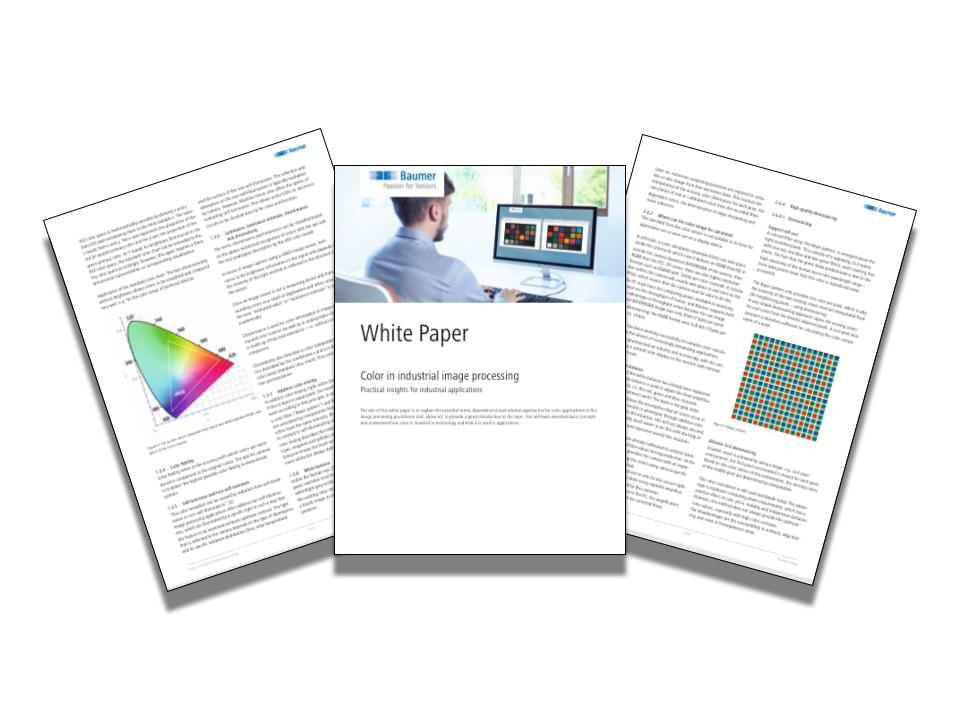
Find out more information by downloading the latest White Paper from Baumer: Colour in industrial image processing: practical insights for industrial applications. This White Paper explains the essential terms, dependencies and solution approaches for colour applications to the image processing practitioner