The latest lenses and optics for imaging in 2026
Optics or lenses are an essential component of any imaging system (Credit: REDPIXEL.PL/Shutterstock.com)
Optics or lenses are an essential component of any imaging system in order to focus the image of the examined object onto the camera sensor. They can be used to remove parallax or perspective error, or provide adjustable magnifications, field of views, or focal lengths.
What are optics for imaging?
Made from transparent materials, such as glass or plastic, lenses can either converge (convex) or diverge (concave) light rays to create real or virtual images. These lenses are often combined in optical systems to enhance image quality, correct distortions, and adjust the field of view.
In early 2026, the definition of imaging optics has expanded beyond traditional glass. Metalenses, ultrathin surfaces using nanostructures to manipulate light, are now entering the commercial market, offering a way to eliminate "camera bumps" on smartphones. Furthermore, lens-free imaging (computational imaging) is gaining traction, using multiple sensors and AI to reconstruct ultra-sharp images without any physical glass at all.
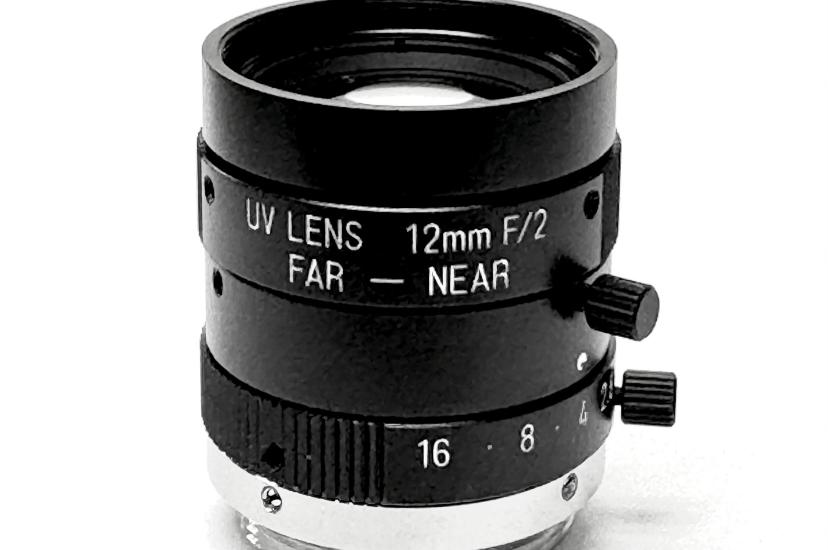
Universe Optic's UV1220HR
Universe Optic's UV1220HR brings advanced UV imaging to a compact 12mm wide-angle format – purpose-built for applications where detail, proximity, and UV sensitivity all matter.
With a fast F/2 aperture and compatibility with UV-B and UV-C wavelengths down to 193nm, the UV1220HR delivers higher resolution than conventional UV lenses. It's optimised for Sony's IMX487 UV sensor, one of the most capable UV imaging sensors currently available, making it a natural choice for cutting-edge machine vision and research systems.
Close-focus capability makes this lens ideal for surface inspection tasks — detecting micro-scratches, identifying materials invisible under visible light, and capturing fluorescence excitation and discharge phenomena. Custom AR coatings can be specified for peak transmission at your target wavelength, and semi-custom configurations including mount changes are available.
Contact us for additional lens specs, and about building a UV imaging solution around the UV1220HR.
SPONSORED BY

What are the applications for optics for imaging?
Lenses continue to evolve to accommodate the changing needs of imaging systems across a variety of sectors. Consumer electronics remain a primary driver, with a shift towards multi-sensor arrays and periscope zoom modules.
Other vital markets include:
- Automotive: Advanced driver-assistance systems (ADAS) now require high-performance optics for 360-degree obstacle detection and cabin monitoring.
- Medical: High-resolution lenses are critical for endoscopes and the growing field of optical coherence tomography (OCT) for non-invasive subsurface imaging.
- Manufacturing: Machine vision lenses are increasingly integrated with edge-AI to perform real-time defect detection on high-speed production lines.
What are the biggest opportunities for optics for imaging?
The global camera lens market has seen robust growth, valued at approximately $6.8bn in 2026, according to the latest intelligence from Global Market Insights. It is projected to reach over $12.8bn by 2035, growing at a CAGR of 6.5%. This evolution is heavily supported by the integration of artificial intelligence (AI) and computational photography.
Smartphone manufacturers now lead this innovation, using AI algorithms for real-time scene optimisation and sophisticated multi-lens systems. A significant trend in 2026 is the use of liquid lenses in industrial and mobile applications, which allow for near-instantaneous autofocus without moving mechanical parts. In the automotive sector, autonomous vehicles are expected to represent a larger share of new car registrations by 2030, driving massive demand for ruggedised, high-clarity lenses that can operate in harsh environmental conditions.
Optics for imaging on the market now
Vendors that offer lens technology include camera manufacturer Basler, which provides a range of standard and premium lenses. Its standard line is optimised for cost-sensitive applications, while the premium line offers higher resolution, lower distortion, and reduced vignetting for demanding industrial tasks.
Computar (CBC) released its 2026 product guide featuring the LensConnect Telecentric Series. These lenses combine precision telecentric optics with USB-based remote control, allowing for seamless integration into automated quality assurance workflows.
Edmund Optics offers an extensive selection of imaging lenses, including telecentric, liquid, and shortwave infrared (SWIR) versions. Their 2026 focus includes advanced "flat-top" beam shapers and expanded aspheric lens options for precision research.
Fujifilm continues to expand its range of prime and zoom lenses. Its Fujinon GF series for large-format cameras remains a benchmark for professional photographers seeking a compact and lightweight form factor without sacrificing image quality.
IDS offers a dedicated C-mount lens series with resolutions up to 10 megapixels. These lenses are designed for durability, with aperture and focus settings that can be fixed mechanically to withstand high-vibration environments.
Kowa lenses are widely used in logistics and food processing for surface and dimensional inspection. Their 2026 portfolio includes specialised lenses for the latest high-resolution sensors used in pharmaceutical defect detection.
Knight Optical provides a wide range of off-the-shelf and bespoke imaging optics, including infrared aspheric lenses for thermal systems and optical bandpass filters for fluorescence microscopy. They work with diverse substrates such as calcium fluoride, sapphire, and germanium.
Optotune leads the market in focus-tunable liquid lenses. These components can change focus within milliseconds and are rated for billions of cycles, making them ideal for high-speed packet sorting and robotic vision.
Resolve Optics specialises in compact fixed and zoom lenses for challenging environments. They are a primary provider of radiation-resistant optical modules designed for use in nuclear reactors and satellite camera systems where standard glass would suffer from radiation 'browning'.
Schneider-Kreuznach recently expanded its Zirconia series with the Zirconia 3.3/90, designed specifically for line-scan sensors in flat-panel display and PCB inspection. These lenses provide uniform imaging performance across the entire field of view.
Sill Optics provides telecentric lenses for machine vision, including recent models that integrate tunable liquid lenses. This allows for high-speed adjustment of focal lengths to compensate for varying working distances on automated lines.
Tamron has expanded its machine vision range with the MA23 and MA111-VIR series. The latter is optimised for 1.1-inch sensors with up to 24-megapixel resolution. In the consumer sector, their 2026 launches include the 35-100mm f2.8 Di III VXD, which offers high-resolution rendering in a lightweight, compact barrel.
Thorlabs offers a comprehensive variety of C-mount camera lenses, including modular zoom components and telecentric lenses compatible with their own CCD and CMOS camera lines. They also provide specialised thermal imaging lenses designed to focus infrared light without spherical aberration.
This is not an exhaustive list. If you provide optics or lenses for imaging and would like your company to be included, please let us know at: editor.imaging@europascience.com